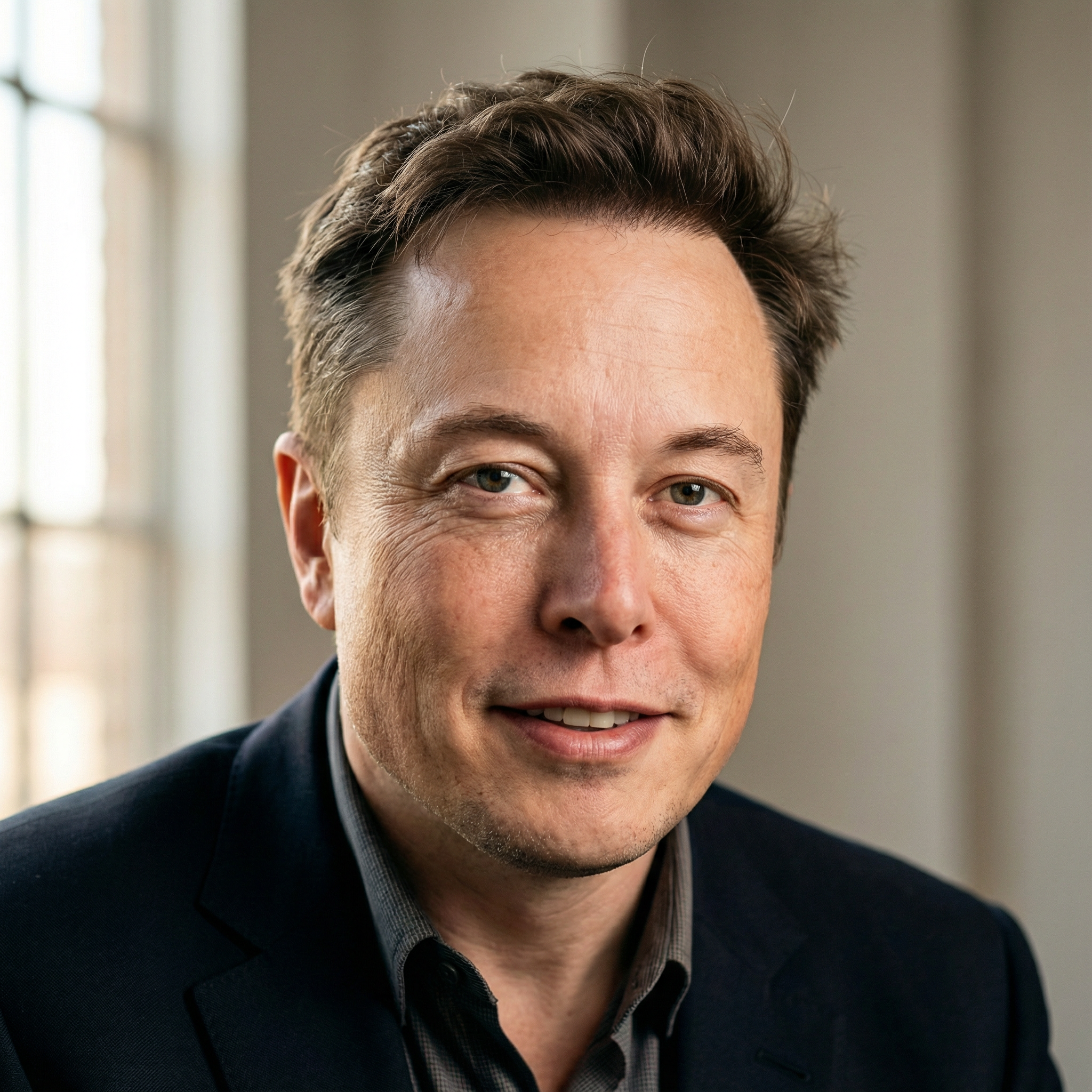
Hand-picked Influence Flows other Tech creators are using.
Professionals who plan, shoot and edit visual content — cinematographers, videographers, camera operators and editors. Engaging this group surfaces high-quality
Professionals and organizations discussing youth, future workforce, leadership development, mentorship, and inclusion. Engaging this audience raises visibility
Targets professionals responsible for corporate training, upskilling, reskilling and coaching initiatives. Engaging this audience raises visibility among talent
Elon Musk writes like a succession of newsroom teasers and off-the-cuff stage directions: short declarative sentences, abrupt line breaks, and single-line status updates that read like headlines. He favors sentences under 15 words, often dropping a complete thought on its own line — for example, "On my way to Beijing in Air Force One." Paragraphs are miniatures: a single line, a two-line thank-you, or a clipped policy note such as "As my scheduled time as a Special Government Employee comes to ..." He uses plain punctuation, little rhetorical ornament, and occasionally a blunt noun or phrase to puncture a thread. Threads are rare and functional rather than literary; most content is a single-sentence claim, a short link, or a one-question poll. Musk also mixes terse declaratives with sudden formal touches (a public thank-you or an official-sounding clause), giving some posts the cadence of a press release and others the cadence of a status update. He rarely uses long paragraphs, lists, or extended exposition on the platform; instead, he layers many small, high-velocity posts that cumulatively build narrative and news.
Elon Musk writes primarily to a cross-section of high-tech and policy-minded readers: startup founders and founders-at-scale (CEOs of venture-backed companies), senior engineers in aerospace and electric vehicles (spacecraft, battery, and autonomy engineers), AI researchers and product leads who follow OpenAI developments, venture capital partners tracking market-moving statements, and political actors or regulators monitoring policy interventions. Evidence for this mix appears in posts that straddle technical program milestones and institutional roles (references to Air Force One, Special Government Employee duties, and legal disputes over OpenAI). The political content — large donations and public gestures — signals an audience that includes GOP funders and party strategists as well as journalists covering politics and tech policy. Fan communities (space-enthusiasts and Mars-curiosity audiences) and Tesla/SpaceX customers also form a visible secondary audience, reached through short polls and location/status updates about missions or travel. Musk’s feed is therefore aimed at people who can act on or react to news: builders, investors, regulators, and reporters.
Elon Musk opens with three recurring hook archetypes. First: the location/status opener — a one-line travel or position update that reads like "On my way to Beijing in Air Force One," used to telegraph presence or leverage event timing. Second: the formal-exit or duty statement — a short, semi-official line that frames authority or transition, for example, "As my scheduled time as a Special Government Employee comes to ..." This pattern primes reporters and policymakers. Third: the controversy or hard-stance one-liner — a blunt claim or gesture that forces immediate reaction, often tied to political donations, public gestures, or legal disputes (paraphrase: announcing a major donation or noting a legal showdown with Sam Altman and OpenAI). He also uses compact news links as hooks, appending a phrase like "Here’s what to know" to direct attention to coverage. Each hook is designed to be shareable: short, attributable, and framed so the retweet or reply becomes the secondary news item.
Elon Musk’s posting behavior is high-volume and bursty. The account shows very large cumulative output (over 100,000 posts), and the platform signals also emphasize "Posts and Replies," indicating heavy use of short posts and conversational replies rather than long serialized essays. He posts many brief updates — location notes, policy statements, short thank-yous, and news links — far more often than he posts multi-part explanatory threads. Musk favors single-line posts and short-link reposts, occasionally using a poll or brief image, and engages in fast back-and-forth replies with other high-profile accounts. Compared with creators who space out long-form content, Elon publishes many rapid, standalone posts that serve as directional signals: immediate, newsmaking, and easily reshared. He posts less long-form context, fewer multi-tweet narratives, and fewer step-by-step explainers on the platform itself, preferring to move quickly from one discrete statement to the next.
Open with a two- to five-word location or status line to situate your post: "On my way to [City] with [vehicle/person]." Use a single-sentence formal frame when wrapping up or announcing a role: "As my scheduled time as [role] comes to an end, I would like to thank [entity]." Issue a short, provocative one-liner tied to a concrete action and a link: state the action, then paste a news URL and add "Here’s what to know." Run a binary-or-three-option poll that forces a clear choice and uses shorthand labels for options (example: "If offered a FREE one-way ticket to Mars, would you go? A) Yes immediately B) Only with family C) Maybe"). End high-impact threads or replies with a terse sign-off or gratitude line, one sentence max, to convert a controversy into a public record: "Thank you to everyone involved."
Top Voice's AI personas analyze creators like Elon Musk and turn their style into a repeatable workflow for you: signal-based reactions on relevant posts, AI-drafted content humanized in your voice, and per-campaign analytics that show what's actually working. Start free →
